 Knotenhirn
Wiki and tacit knowledge: what belongs in the wiki and what does not
Updated 6 November 2026 · by Michael Schwarz
The wiki is for what people read in one go and what stays valid for a while: architecture, processes, handbooks, policies. What does not fit in the wiki is the knowledge in people's heads: small edge cases, agreements, workarounds and the why behind decisions. For that you need a lighter place beside the wiki, where a note is written in a minute and which people and AI agents search. The wiki keeps its job.
What a wiki does well
A wiki organises knowledge into pages and spaces. Anyone who wants to understand how a system is built, how a release works or which rules apply to holidays reads a page from top to bottom and comes away with a picture of the whole. Such pages are worth the work that goes into them: someone thinks about the structure, others review it, and the page stays correct for months.
That is what a wiki is built for, whether you use Confluence or something else. None of that changes, and there is no reason to write these pages anywhere else.
What still stays in people's heads
Alongside this documentation, smaller knowledge comes up every day. For instance: one customer receives invoices only as a PDF by post. An import fails if the file ends with a blank line. An interface was deliberately not extended because a partner cannot handle it. That is two or three sentences. Whoever knows them rarely needs them, but when they do, it is urgent.
That is too little for a wiki page of its own. Working it into an existing page takes time: which page fits, where in the text, who is responsible for it? So nobody writes it down. It stays with the person who experienced it, in a chat or in a closed ticket. When someone asks about it, the answer depends on whether the right person happens to be around.
How to tell what goes where
- Is it read in one go or looked up specifically? In one go points to the wiki, looked up to a short note.
- Does it need a structure, or are a title and a few sentences enough?
- Does it apply to everyone, or only to one customer, one module, one outage?
- Does it rarely change, or will a new edge case come along next week?
- Would anyone write it down if they first had to find a suitable page?
The line is not rigid. When many notes gather around one topic, that is often the sign to turn them into a wiki page. The notes have then done their job: they captured the knowledge before anyone had time for the full version.
A light place for tacit knowledge
Knotenhirn is made for exactly this knowledge. A note has a title and a text in Markdown, nothing more. You do not have to choose a folder: notes organise themselves into topics, and when a topic grows, Knotenhirn splits it. With links you connect notes that belong together.
Finding things works through the search, which combines full text and meaning. So whoever searches does not have to hit exactly the words in the note. AI agents such as Claude Code or Claude Desktop use the same search via MCP. They answer with your notes as the source and record themselves what comes out of a conversation.
Seeing which knowledge is missing
Tacit knowledge has one property that makes it hard to grasp: you only notice it is missing when someone asks for it. Knotenhirn makes these questions visible. When an AI agent searches for something and finds nothing, Knotenhirn collects the search on the knowledge gaps page and groups similar questions together.
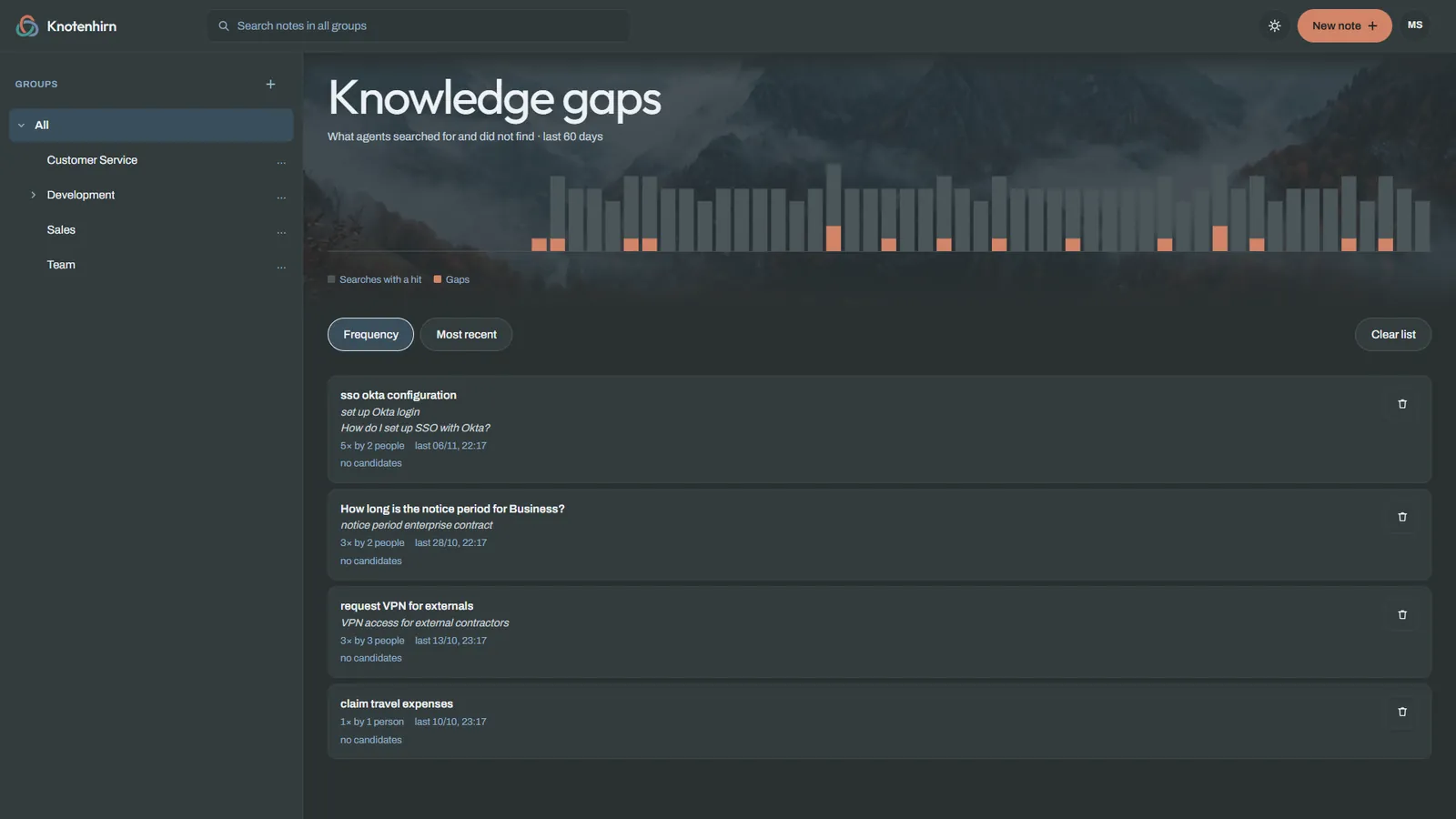
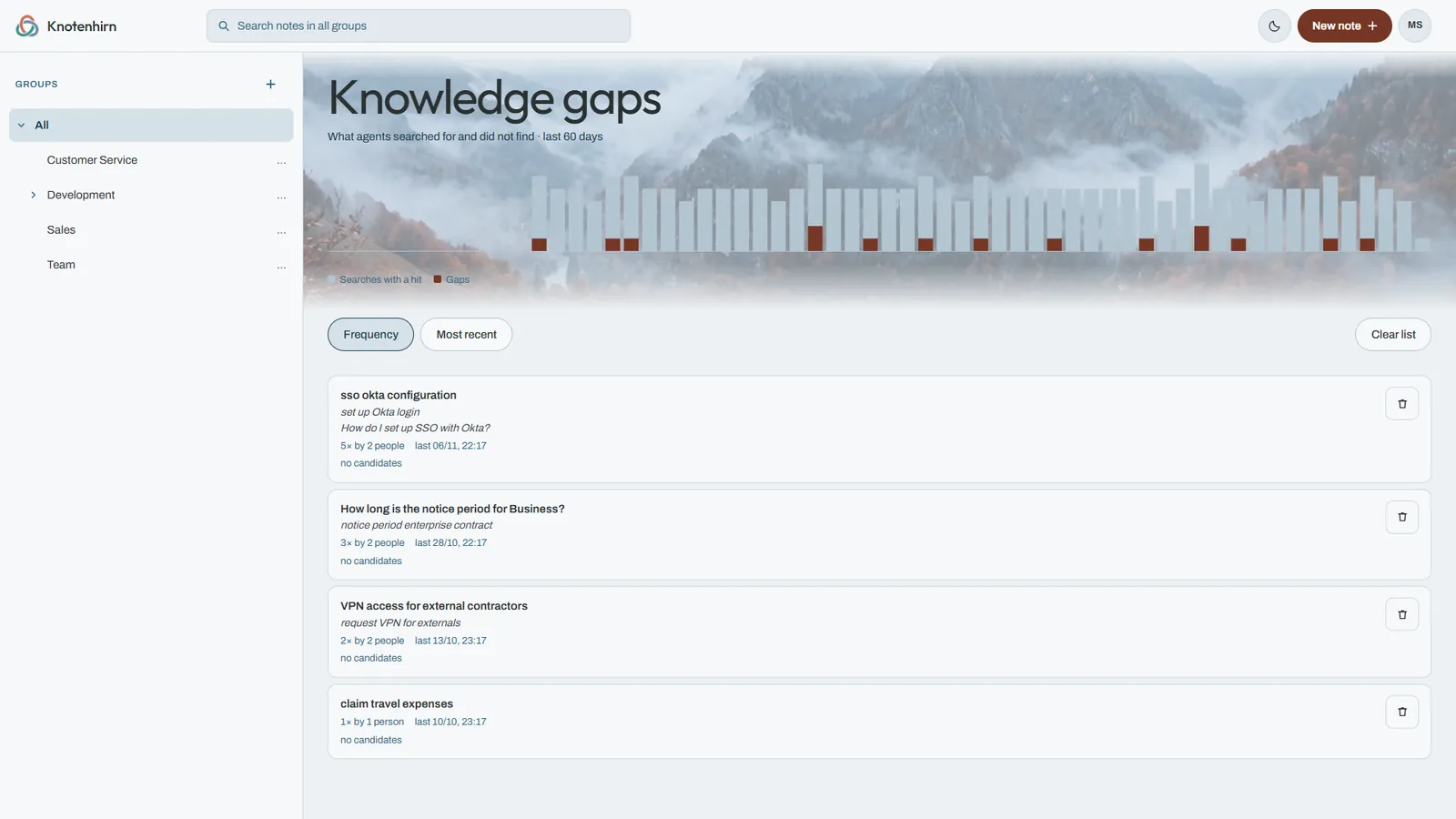
An example: the list shows the question about the notice period of a contract model three times, asked by two people. Someone in sales knows the answer. That person writes a note of three sentences, and from then on people and AI agents find the answer. If this later becomes a detailed overview of all contract models, that overview belongs in the wiki.
The overview counts people but shows no names. The point is what is missing, not who asked.
Wiki and Knotenhirn side by side
Many teams keep their documentation in the wiki and, in Knotenhirn, what they learn every day and want their AI to know. The wiki remains the place for what you write down at leisure. Knotenhirn catches what would otherwise land nowhere. Together, the two cover more than either one alone.
Try it with your team
Try Knotenhirn free for 14 days, with no payment details. The trial does not turn into a subscription automatically.